

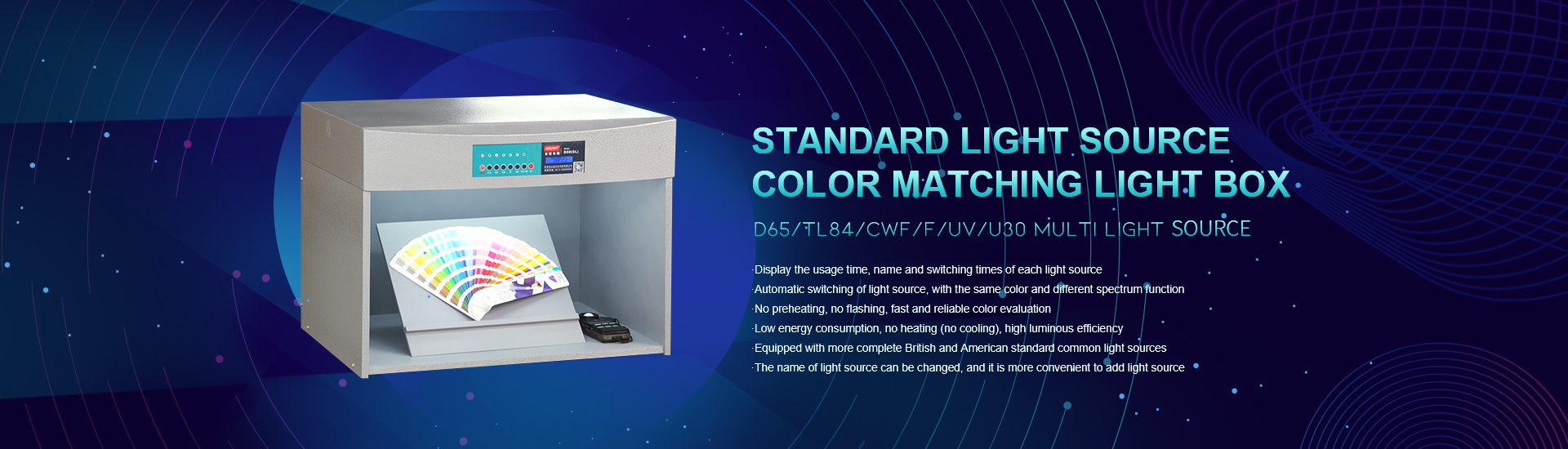




Nowadays, it is very popular in the industry to use a standard light source box to provide a standard light source environment for detecting colors, but why use a standard light source to observe colors? What exactly does a standard light source do? It is not possible to observe directly. Many people may have questions in this regard. The reasons are explained below.
Because the color of an object is a reflection of the spectrum that appears after light hits the surface of the object. Objects show different colors under different light sources. Natural light is an ideal light source for observing the color of objects, but due to time and environment constraints, people cannot observe the color under natural light at all times. In most cases, people can only rely on artificial light sources to observe colors. In order to observe the color accuracy, it is necessary to use an artificial light source that is close to the natural light spectral component, that is, a standard light source.
Observing color is inseparable from the light source. Without light, there is no color. The spectral content of the light source determines the color content you can observe. Natural light is the ideal light source for viewing colors because it contains the spectral components of all colors. However, limited by time and occasion, it is impossible for people to observe colors in natural light at all times. Most of the time and occasions, people can only rely on artificial light sources to observe colors.
In order to effectively compare the quality of light sources, you need to view and compare the color rendering index (CRI) value of the light source. CRI = 100 for natural sunlight, which means that 100% of the colors can be seen correctly under this light source environment. The closer the CRI value is to 100, it means that under the illumination of the light source, the smaller the difference between the displayed color and the color under natural light, the more realistic the color is.
Straight fluorescent tubes are artificial light sources commonly used to observe colors.
It can be divided into three types: 1. Three primary color fluorescent tubes 2. Multi primary color fluorescent tubes 3. Full-chromatographic fluorescent tubes


