

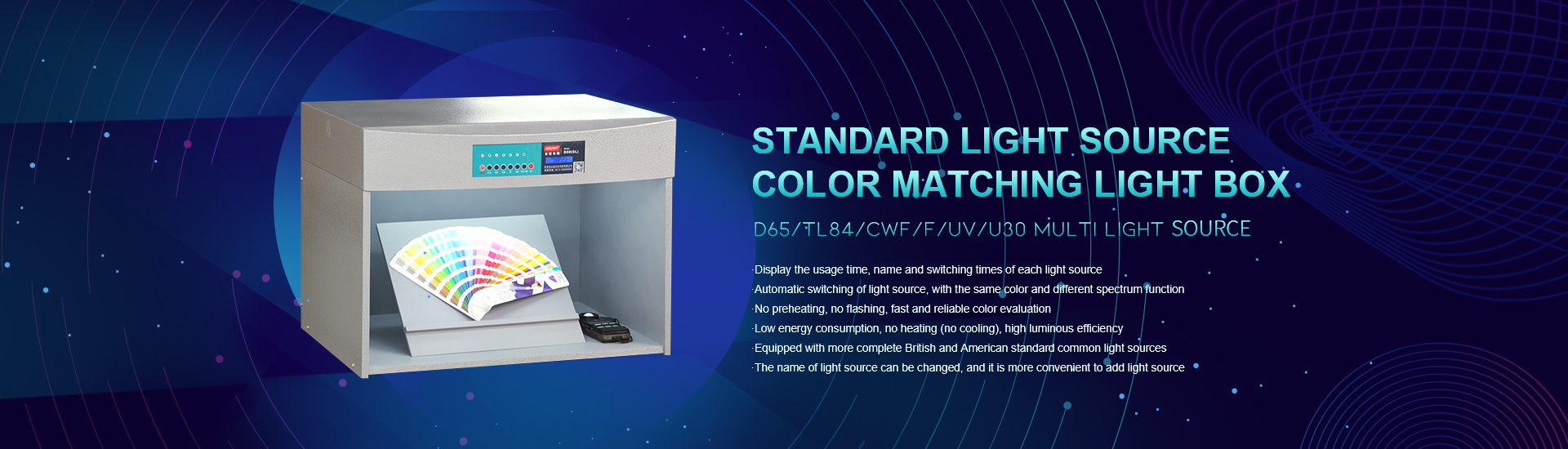




As we all know, observing color is inseparable from observing the light source. Without light, there is no color. Natural light is an ideal light source for observing colors. However, due to time and occasion restrictions, it is impossible for people to engage in color matching work under natural light at all times. Most of the time and occasions, people can only rely on artificial light sources for color matching. If an artificial light source is used to observe the color, this phenomenon often occurs. The color of two objects looks very consistent under one artificial light source, but the observation under natural light (or another artificial light source) is differ greatly. This phenomenon is called the metamerism of an object in physics. In order to overcome the impact of metamerism on product quality during color reproduction, the International Organization for Standardization (ISO) and China's Bureau of Quality and Technical Supervision require the industry to engage in color reproduction and matching, such as advertising art, printing and dyeing , Pigments, coatings, ink manufacturing, etc. use standard light sources to observe the environment to observe colors, and engage in color reproduction and matching. To this end, the International Organization for Standardization formulated a standard in 2000, namely ISO3664: 2000. In this standard, the spectral requirements of the artificial light source used in the observation environment of the standard light source, the brightness and uniformity requirements of the light source, and the requirements of the surrounding environment of the light source are specified in detail.
1. Spectral requirements of the light source
According to the requirements of ISO3664: 2000, ordinary fluorescent tubes must not be used as a light source for viewing colors. Special fluorescent tubes must be used that meet the following technical requirements:
(1) The color temperature of the light source must be 5000K or 6500K, that is, the observation of color under this light source's color temperature is basically similar to the observation of natural color in 8 to 10 am in most parts of China. effect.
(2) The color rendering index Ra> 90 of the light source, that is, under this light source, more than 90% of the colors can be correctly observed.
2. Brightness requirements of light source
Observing the color of an object requires a certain amount of light, and you can imagine that you can't see anything in the dark room. According to the requirements of ISO3664: 2000:
(1) The brightness of the light source on the surface of the observed object through reflection should reach 2000 Lux (+/- 500 Lux). The illuminated surface is within the range of 1mX1m, and the brightness of any point must not be less than 75% of the brightness of the center of the illuminated surface
(2) The brightness of the light source on the surface of the observed object through transmission should reach 1270cd / m2 (+/- 320cd / m2)
(3) The brightness of the display should reach> 75cd / m2
3. Requirements for the surrounding environment of the light source
Observing color requires not only a standard light source and suitable light source brightness, but also strict requirements on the environment around the light source:
(1) The other illumination light sources around the observation light source must not directly or indirectly affect the surface of the observed object.
(2) Observe the wall panel around the light source, the top and bottom (including the observer's own clothes) can not use other colors, only neutral gray with a reflectance <60%.
(3) When observing a color transmission photo, a frame with a height of 50 mm or more must be left around the photo, and the color of the frame must be black with blackness> 90%.
4. Softness requirements of light source
It is not possible to collect the light sources and illuminate them uniformly and gently on the surface of the illuminated object by relying only on a few standard light source lamps. This means that the standard observation light source must have a scientifically designed surrounding light system to ensure that the energy of the light emitted by the fluorescent tube is illuminated as evenly as possible on the surface of the illuminated object, and there is no light glare or light. Shadow.
5. Color temperature (K)
The color temperature of a light source is defined by the burning temperature at which the color that appears when the light source emits light matches the color that appears when an absolute black body is burned at high temperature. Its unit is the absolute temperature Kelvin (K). The higher the K value, the more the colors appear to be white and blue; the lower the K value, the more the colors to be yellow and red.
5000K (D50)
A standard light source tube with a slightly warmer (yellow) luminous color is widely used in the field of advertising art and prepress. But according to ISO3664: 2000, this light source is now also mandatory for printing and other color management processes.
6500K (D65)
A standard light source with a slightly cooler (blue) hue. Previously in Europe and the United States, this light source was used in the printing field. However, according to ISO3664: 2000, this light source is gradually being replaced by a D50 light source. However, in our country, D65 light source is still the standard light source tube commonly used in the printing field.
6. Color rendering index (Ra)
The color rendering index is used to measure the ratio between the color that can be seen under natural light and the color that can be seen under a certain light source. ÷ Colors that can be seen under natural light.
Ra represents the color rendering index of a light source. The closer Ra is to 100%, the smaller the difference between the color displayed under the light source and the color displayed under natural light.
Note: Color temperature and color rendering index are two different physical concepts. The color temperature only reflects the color of the artificial light source, which is warmer or cooler. The color rendering index reflects the types of colors that can appear under the illumination of a certain light source. High color temperature does not equal high color rendering index, and high color rendering index does not equal high color temperature.


