





1. Meaning
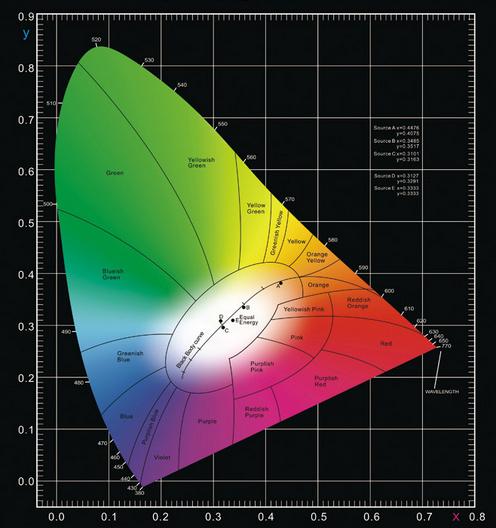
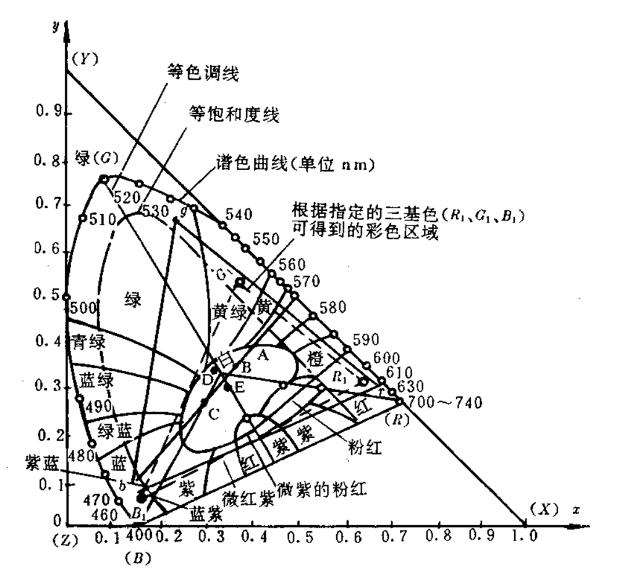
The colors in the figure include colors that can be obtained naturally. This is a two-dimensional planar space graph, a plane formed by the x-y rectangular system. It is designed to adapt to people's habit of discussing variable relationships in the plane coordinate system. In the process of designing the figure, many mathematical transformations and calculations were performed. The meaning and function of this figure can be summarized into two sentences: (1) Represent the basic laws of color vision. (2) Represents the general law of color mixing and decomposition.
2. Coordinate system-x, y rectangular coordinate system.
x-represents the relative magnitude associated with red.
y——Represents the relative magnitude related to green.
z-represents the relative magnitude associated with blue. And z = 1- (x + y)
3. Shape and outline
Shape-tongue shape, sometimes called "tongue curve" diagram. A closed area surrounded by a tongue-shaped peripheral curve and a straight bottom line. Tongue-shaped peripheral curve-is the color trajectory of all monochromatic light of visible light, each point represents the color of monochromatic light of a certain wavelength, the wavelength is from 390nm to 760nm. Beside the curve. The corresponding wavelengths of some characteristic color points are marked. For example, 510nm-520nm-530nm and so on. Bottom straight line—A straight line formed by connecting the 390nm point to the 760nm point. This line is called a purple-red line.
4. Color
This is a color map. The colors in the area include the colors that can be physically realized. Unfortunately, it is difficult to obtain such standard material, which is often distorted by transfer.
5. Application value-quantitative representation of color
Color is represented by (x, y) coordinates. White should be included in the concept of "color".
6. The significance of several feature points
(1) Point E—the coordinate point of the isoenergy white light point
Point E is a mixture of three primary colors with the same stimulus energy. But the luminous fluxes of the three are not equal. CCT at point E = 5400K.
(2) Point A—CIE specifies the chromaticity coordinate point of a standard white light source. This is a pure tungsten filament lamp with a color temperature value of CCT = 2856.
(3) Point B—A standard light source coordinate point specified by CIE CCT = 4874K at point B, which represents direct sunlight.
(4) Point C—A standard daylight source coordinate point (daylight) confirmed by CIE CCT = 6774K at point C.
(5) Point D—Sometimes labeled as D light source is called typical daylight, or reorganized daylight; CCT = 6500K.
7. Three special lines
(1) Black body color temperature trajectory: In the middle of the tongue-shaped curve, across the white area, there is a downward curved curve. This is the black body color temperature trajectory. This curve represents the trajectory of the color change of the black body at different temperatures. The color temperature varies from 1000K to infinity. But in practice, the 1000K-1400K range is commonly used.
(2) Monochromatic light trajectory: The tongue-shaped curve in the chromaticity coordinate chart, the trajectory of the color corresponding to the wavelength of visible light. Any point on the curve represents the wavelength of a light and its color.
(3) Purple-red line: a straight line connecting the two ends of the tongue curve. Represents the trajectory of the mixed color of red and purple. Fuchsia line
8. 20 specific color zones
The area enclosed by the tongue curve is divided into 20 color areas. In each area, the colors are considered to be basically the same. Each color area is an average dominant wavelength, or a complementary dominant wavelength, and there is a corresponding English name. Their English-Chinese names are compared as follows:
1. Red—Red 2. Pink—Pink 3. Reddis Orange—Orange Red 4.Yellishpink—Pink Yellow 5.Orange—Orange 6.Orange-Yellow—Orange Yellow 7.Yellow—Yellow 8.reenish Yellow—Yellow Green 9 .Yellow Green—green yellow 10.Yellowish Green—light yellow green 11.Green—green 12.Bluish Green—light blue green 13, Greenish Blue—light green blue 14.Blue—blue 15.Purplish Blue—light purple blue Color 16. Purple Violet—violet purple 17.Reddish Purple—light red purple 18. Purplish Pink—light purple pink 19. Purplish Red—purple red 20. Central area—white light area
9. Complementary light and color
If two colors of light can be obtained by mixing in a certain proportion, the two colors of light are called complementary. In the chromaticity coordinate chart, any pair of straight lines passing through the white area can find a pair of complementary color lights. Of course, a set of complementary colors of light can also be found through the two ends of a straight line passing through the point E of the isotropic white light point. In the chromaticity coordinate diagram, the light color of any two points is a straight line connecting the two points, and the light color of the mixed light color is always at a certain point on this straight line. If the straight line does not pass through the white area, the light colors at these two points cannot be called complementary.
10. Mixing of white light and other colors of light-dominant wavelength and complementary dominant wavelength
Mix white light with an appropriate spectral color to make up any color you want. If the selected white light is E-point white light. If any point C is selected, connected to CE and extended, and crossed on the monochromatic trajectory, the wavelength of the C ′ monochromatic light is called the main wavelength of the C point light. The dominant wavelength λ represents the dominant hue of the spectral color at each point on the line. If you choose point A in the FEN triangle to connect to EA, but you ca n’t extend it in the direction of A, you should extend the line to the upper left and intersect at point A 'on the monochrome trajectory line. The wavelength of point A' is called Complementary dominant wavelength at point A. The complementary color dominant wavelength is also the dominant hue representing the color of each point on the AA 'line.
11. Quantitative representation of color shade
The hue in the color field is similar to the tones in music. A tune in the music includes C key, F key, etc. In chromaticity, the main wavelength is used to indicate the hue. There are high-pitched and low-pitched pronunciations in music. Corresponds to the color shade. The intensity of the color is represented by the excitement purity Pe. (Refer to the figure in Section 11) Obviously, on the line, the color of point C 'is darker, and then gradually fades, and at point E, it becomes completely white.
12. Blend of color light
The x y chromaticity coordinate graph can be used to represent the color mixing relationship of any two colors of light.
Are the two spectral colors in chromaticity coordinates. To mix two kinds of light, as long as two points are connected, a straight line is obtained, and the color point of the mixed color result is necessarily at a certain point on the straight line.
13. Color Tolerance
On the chromaticity coordinate chart of xy, each point represents a certain color. The color of any one point and the surrounding neighboring points should be different. But if the points are closer together, human eyes cannot distinguish. Only when the distance between two points is large enough can we feel the difference between them. The range that the human eye can't feel the color change is called the color wide capacity. Some studies have shown that the wide capacity of color is not the same at different positions on the chromaticity coordinate chart. The wide capacity of the blue area is small, and the wide capacity of the green area is large. In other words, the same distance between different regions of the chromaticity diagram cannot represent the same chromaticity difference visually. This is a defect of the chromaticity coordinate chart.


