







Quantitative expression of color perception difference is expressed from the difference of three color attributes of lightness, hue and chroma. The difference in lightness indicates the difference in shades, the difference in hue indicates the difference in hue (ie, reddish or blueish, etc.), and the difference in chroma indicates difference in vividness. Color difference evaluation is very important in industry and commerce. It is mainly used for color matching in production and color quality control of products.
In 1931, CIE (International Commission for Standard Illumination) established a series of color space standards representing the visible spectrum. Since any color can be composed of the three primary colors of RGB, the CIE-RGB primary color system is defined. However, this system has an obvious disadvantage. When calculating the color tristimulus value, a negative value appears, which brings inconvenience to a large number of calculations. Since any kind of primary color system can be switched from one system to another, one can choose any desired primary color system to avoid negative values and is easy to use. Based on this, CIE also recommended the CIE-XYZ system. This system uses the imaginary three primary colors, X, Y, and Z, which do not correspond to the visible colors.
CIE-XYZ's three primary color stimulus values X, Y, and Z are very useful for defining colors. The disadvantage is that it is more complicated to use and not intuitive. For a given color, if its brightness is increased, the luminous flux of each primary color must be increased proportionally, and the chromaticity value is only related to the wavelength (hue) and purity, and has nothing to do with the total radiant energy, so the color is being calculated For the chromaticity, the X, Y and Z values are normalized with respect to the total radiant energy = (X + Y + Z), and the color matching equation can be normalized as x + y + z = 1. Z can be determined according to the color coordinates (x, y), but three primary color stimulus values X, Y, and Z cannot be derived from x and y only. It is also necessary to use a Y value carrying brightness information, which is the same as the Y stimulus value in XYZ Consistent. This defines the CIE-xyY color space.
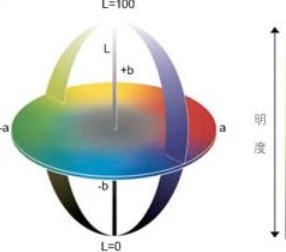
Figure 1 LAB color space coordinates
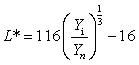
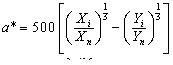
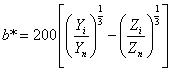
The distance between the XYZ system and the two colors represented on its chromaticity diagram is inconsistent with the change perceived by the color observer. This problem is called the problem of perceptual uniformity. In order to solve the problem of the perceived consistency of the color space, the experts performed a non-linear transformation on the CIE-XYZ system and formulated the CIE-L * a * b * color space. The color space coordinates are shown in Figure 1. In the CIE-L * a * b * color space, the L value represents the brightness of the color, the a value represents the green-red value of the color, and the b value represents the blue-yellow value of the color. The L, a, and b values can be calculated by XYZ. The calculation formula is as follows:
 2.1
2.1
 2.2
2.2
 2.3
2.3
Among them, XiYiZi is the tristimulus value of the reference sample or the measured sample, and XnYnZn is the tristimulus value of the standard illuminant.
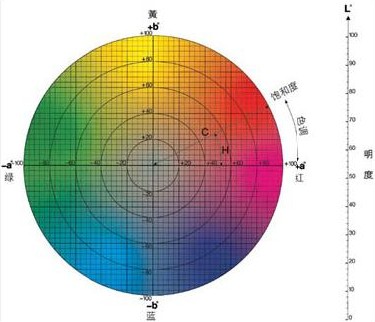
Figure 2 LCH color space coordinates
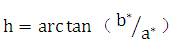
The CIE-LCH color space is transformed from the CIE-L * a * b * color space. It uses L to represent the lightness value; C to represent the saturation value and H to represent the column coordinates of the hue angle value. The color space coordinates are shown in Figure 2. The three attributes people describe in daily life are lightness L, hue H, and saturation C. Therefore, using CIE-LCH color space to describe colors is more in line with people's habits of color description in daily life.
 2.4
2.4
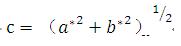 2.5
2.5
If we simply judge a certain color based on a set of L * a * b * or Lch values, but when we compare the two colors, we can use the parameter difference Determine the difference between them. By comparing the product and standard color sample parameter values, we can easily know the color status of the current product. Through two sets of L * a * b * values, we can calculate the color difference between the two colors. The color difference is calibrated with △ Eab *, △ L *, △ a *, △ b *. The CIELAB color difference formula is as follows:
 2.6
2.6
 2.7
2.7
 2.8
2.8
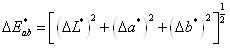 2.9
2.9
△ E * total color difference, △ L * large means white, △ L * small means black, △ a * large means red, △ a * small means green, △ b * means yellow, △ b * Small means blue.
In L *, a *, b * rectangular coordinate systems, cylindrical polar coordinate systems of L *, c *, h * can be derived. The formula is as follows:
 2.10
2.10
 2.11
2.11
 2.12
2.12
 2.13
2.13


